
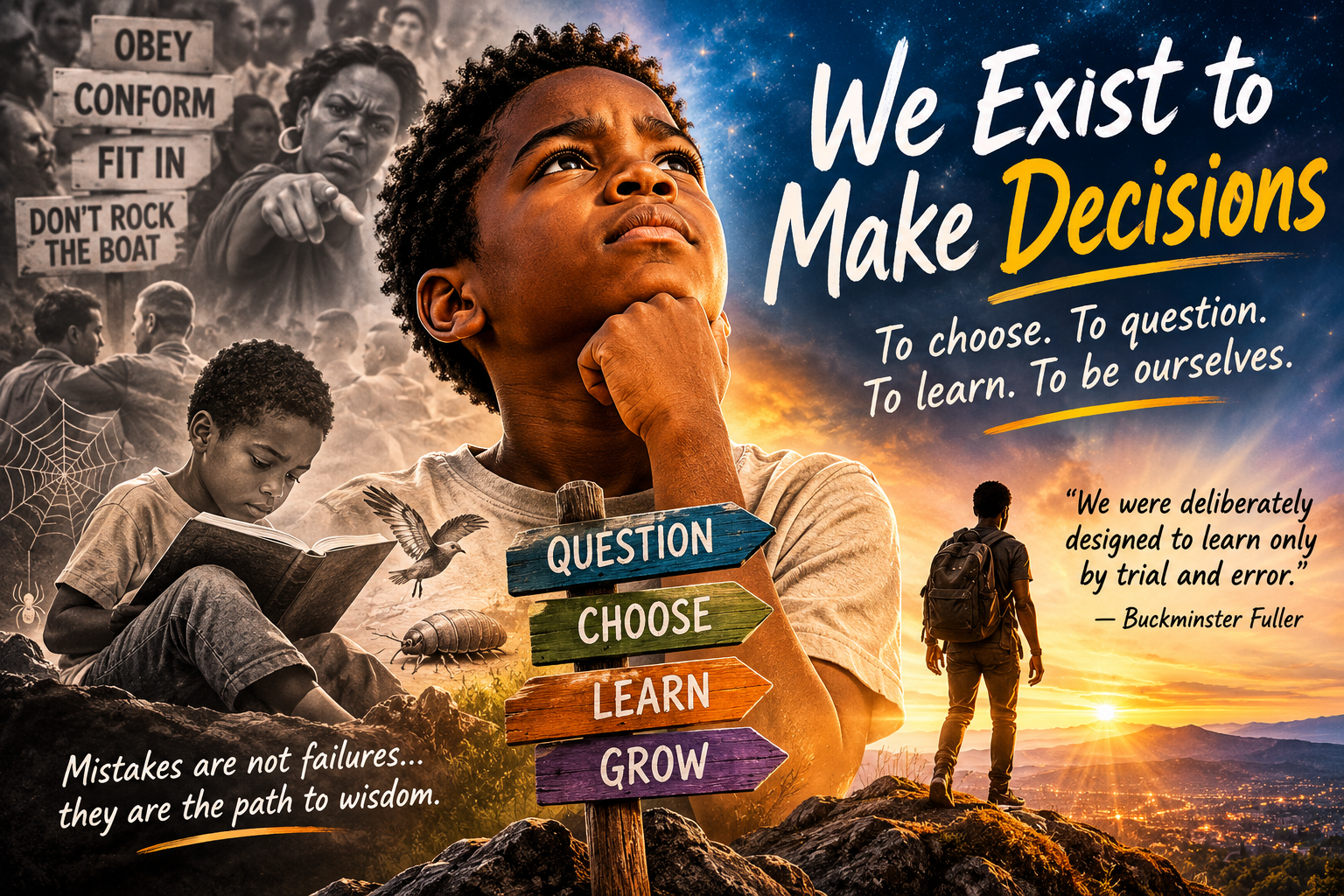
We Exist to Make Decisions
Do you know why you are on earth? You are here to make decisions. That’s it. That’s what humans are here for. And, I can tell that after decades of field research that most of us suck at it, not because we lack the capacity, but because most of us do everything we can to avoid making decisions at all.
I first realized humans exist to make decisions and that we suck at it when I was a child. I was an extremely contemplative kid. So one day, I was thinking about what made humans unique among all other living creatures. I observed how every creature had something beautiful about how they showed up in the world–the way spider’s make webs, the way roly polies balled up, the way birds fly, or the acrobatics of squirrels. They were all so admirable. But what about us? What was the beautiful thing that we did that other creatures couldn’t do? I sat still with this question for a moment. And then like a flash, it hit me that humans make decisions and learn from our mistakes.
I wouldn’t go so far as to call it a satori (enlightenment) moment. But, I can tell you that this realization instantly changed my life from that day to this. Immediately, I started paying attention to my decisions and I got curious about my process of making them. It didn’t take long for me to discover that, besides what books to read, I was not making very many decisions on my own. I was five after all. So, my mom, grandmother, and other folks who were older than me were basically making my decisions. But now that I knew why I was on earth, I didn’t want them making decisions for me unless they could explain them to my satisfaction. Only then could I determine whether I agreed or not and thereby make a decision whether or not to go along with the decision they were trying to make for me.
Well, it didn’t take long before I discovered that the “decisions” my family were making for me fell in a few categories. They were decisions to:
- Keep me alive
- Keep me from going to hell if I died
- Keep me from embarrassing them
- Turn me into the person they were projecting onto me
That was it for the most part. Now at 6, I didn’t know the word projection until my freshman college PSYCH class. But, I knew what was happening and I wanted no parts of it. I wanted to make my own decisions. And the world around me was not ready for it at all.
Who Do You Think You Are Pedro?
Once I realized what was happening in my family and eventually discovered was happening all around me, I became what some people would consider “a handful”. My questions became relentless. I demanded that people knew what they were saying and why they were saying it or I reserved the right to withdraw my participation. And I was willing to deal with the consequences of withdrawal. And at that time in my household that meant corporal punishment. If you don’t know what that means, it means beatings. But, I was willing to take beatings for not going along with any decisions that didn’t make sense to me. And beatings, I received–from my mom, my grandmother, other family members, kids in my neighborhood, and even my second grade teacher in front of the whole class because at that time parents could still give the teacher permission to beat children. And my mother was the only one who did.
Now hearing how much physical coercion I received you might think I was a bad child. I was not. My favorite thing in the world at that time and to this day is sitting in a chair quiet and, with my eyes closed, trying to be as still as possible. Reading is a relatively close second. And writing is my third favorite thing. So, I was not delinquent. What I eventually was told by my future mentor, Marshall Thurber was that I was a “positive deviant”. I may share more about that in a future post. But here is what you need to know for the sake of this piece. The reason why so many people were trying to coerce me into making the decisions that they thought I should make was because, they had either unconsciously accepted the script that our society had projected onto them or they were often unconsciously resisting it. Either way, they were not making decisions. They were conforming to a system. And all a system is is a predetermined compulsory decision engine designed to maximize duplication and minimize, if not eradicate, variation. And eventually, a system becomes a culture. And a cultures soon usurps ancestral memory, imagination, and aspiration and simply becomes, “the way things are done around here”. When that happens new ways of doing things become a threat. And that’s how people saw me. Many still do. And the saddest thing is that they don’t even know why. But, it all comes down to not matching expectations. Which unconsciously terrifies people.
For years, people would be so disturbed by me not matching their expectations that they would ask, “Who do you think you are?” What I know now is that whoever you think you are, you are. And I don’t think–I know–that I am here to make decisions and learn from my mistakes. That’s it. Just like the rest of us.
Mistake Mystique
Decades after having lived my life from the vantage point that I am here to make decisions and learn from my mistakes, I came across the work of Buckminster Fuller (Bucky) who had written an essay called Mistake Mystique in 1977. And even though I didn’t need the validation, it was awesome to discover that I was thinking along the lines of someone who I would come to consider a genius. In it he said this:
“We were deliberately designed to learn only by trial and error. We’re brought up, unfortunately, to think that nobody should make mistakes. Most children get de-geniused by the love and fear of their parents that they might make a mistake. But all my advances were made by mistakes. You uncover what is when you get rid of what isn’t.”
I know it is a hard pill for many of us to swallow, but Fuller is right. I can tell you this from the trenches. Literally, since I was 5 years old, I have been dealing with the awareness that most of us spend most of our lives trying not to make mistakes rather than trying to learn from them. That is why much of what we see in our systems and institutions today is recycled or repackaged variations of what stopped working a long time ago or is on its way to fail completely. Most of us are terrified of making decisions because we are afraid of making mistakes. And our systems are designed to reward acquiescence to the status quo, with added bonuses if you can facilitate reverting back to the way things used to be. And it is everywhere.
Even when people try to do a new thing, they try to do the new thing in the old way for the very same reasons–they are afraid to make mistakes. And it is a rare person that can see through this tendency. That is why so little fundamentally changes. Another one of my favorite quotes from Bucky is:
“You never change things by fighting the existing reality. To change something, build a new model that makes the existing model obsolete.”
I think about this about 360 days a year. Even though, I have no idea how I am doing it, I know that, through trial and error, I am building a new model for how to live a full life. There is no short supply of seeing what doesn’t work when it comes to the relational infrastructures of this society. And yet most of keep doing the same things. So many of our systems are structured for people operating from gambler’s fallacy. It is so obvious. So all I have to do is suck less and less every day by making decisions and learning from my mistakes and I know that eventually I will get to my ideal or at least die trying. Because as Bucky said, “You uncover what is when you get rid of what isn’t.”
Every True Decision Is Iterative and Integral
One thing that you will learn to appreciate when you start embracing ‘mistake mystique” is the awareness that every true decision we will ever make is both integral and iterative. Whether it is a hiring a process, building a family, or destroying your life with bad habits because you’re stuck in unconscious resistance to a system that you know isn’t working but can’t articulate your way out of, when you make a decision it includes every decision that came before it throughout all history, relationships, and aspirations. Does that sound far fetched? It isn’t.
Agreeing with Bucky that all progress in the world has come from making mistakes covers the iterative part. Essentially whenever we engage with any system consciously, we are part of the never ending iterative process that includes everything that came before it. Our contribution begins with taking everything that came before us and making new decisions and eventually new mistakes to learn from.
And the integral part, according to Ken Wilber, necessitates that when approaching any system, or anything at all, the best outcome comes from creating from a vantage point that “leaves nothing out”. If you are not familiar with Wilber’s Integral Theory, the core framework is built on something he calls AQAL which stands for All Quadrants and All Levels, but also encompasses all lines, states, and types of everything. For example to get the greatest understanding of typologies like the Enneagram, would necessitate looking at each type from the boundariless vantage point of all types. And that extends “upward” through all of the variations of every aspect of the AQAL framework until you are looking at any one thing from the point of view of EVERYTHING. And then from there, you make a decision to draw a boundary that determines that which you are saying yes to and everything else that you are saying no to. That is how decisions are made. Unconsciously, we all know this. And that is why for most people, every decision feels like it carries with it the weight of the entire Cosmos. It is because it does. AND MORE.
According to Integral Theory, it isn’t just the Cosmos that’s influenced by our every decision and we, as part of everything, are being influenced by all other decisions and indecision. No, Wilber says it’s the influence of the Kosmos, with a K, referring to the Pythagorean concept that mirrors Wilber’s AQAL framework–an all encompassing organized multidimensional reality that isn’t simply reduced to the Cosmos, or the physical dimensions, but also every dimension of interiority imaginable and as of yet unimaginable. This means that every decision, whether we are mindful of it or not, is inextricably woven into every physical, biological, mental, and spiritual dimension. Or as Rev. Dr. Martin Luther King Jr. put it, “We are caught in an inescapable network of mutuality, tied in a single garment of destiny…What happens to one directly, happens to all indirectly.” I bet you had no idea you were that powerful. But each of us is. And that is what terrifies us and keeps us from actually making decisions. We know that the whole world is depending on us.
Of course, I am being slightly facetious. But, at the same time, after four decades of paying attention to humans and our incredible efforts to avoid making decisions consciously, I can tell you that every system that we have running on autopilot right now is failing us because we have virtually fallen asleep at the wheel. Our ability to discern has virtually atrophied. We feel the weight of the world like Atlas but have forgotten how to lighten the burden with wonder. We don’t want to be surprised. We think there is safety in having everything figured out. But, true life is not calculable. It is iterative and integral. And our decisions have to be as well.
Every decision we make, our every action, our every word is based on the construction, conscious or unconscious, of boundaries. I am not now referring to just a self-identity boundary—important as that certainly is—but to all boundaries in the broadest sense. To make a decision means to draw a boundary line between what to choose and what not to choose. To desire something means to draw a boundary line between pleasurable and painful things and then move toward the former. –Ken Wilber
How I Can Help Folks Stop Sucking at Making Decisions
Nowhere have I seen just how difficult it is for us to make decisions and learn from our mistakes than in the worlds of corporate recruiting and consulting. It is wild the degree to which “leaders” do everything they can to avoid making a mistake. I wasn’t a recruiter for two weeks before I realized that most hiring managers are not trying to hire the right person. They are trying to avoid hiring the wrong person. In other words, they are trying not to make a hiring mistake. That’s why they bring in consultants and external recruiters so often–because if a “mistake” is made, they don’t want it to be their fault. That’s it. Organizations largely hire consultants because they are afraid of making decisions that can reflect poorly on them. They need consultants to push them to do what they could figure out on their own if they were willing to do trial and error. But then, they wouldn’t have someone to blame if things don’t go right.
Besides seeing this on the recruiter side, I saw this so much on the candidate side it is ridiculous. Here is one of the most stark examples.
A little over a decade ago, I was interviewed by a company I really wanted to work for. At the time, I couldn’t imagine a better fit for either of us. They were looking for someone with a technical recruiting background and sales experience, with a high capacity to communicate cross culturally, and had some Mandarin Chinese proficiency. I had all of these things.
I had been a recruiter for 8 years and had worked with numerous tech companies. I had previously been a Chinese Language Analyst at the NSA, and I literally sold cars in between those roles as one of three Chinese speaking car salespeople in an area of Georgia with a high percentage of Chinese people. On top of this, I had a certification in Diversity Training Management, an associates degree in communications electronics, had attended an extremely diverse language institute, and had a Masters in Theological Studies with a concentration in world religions, plus had worked with refugees to help them get acclimated to America.
In this role, besides recruiting, I was supposed to be a go between with Chinese managers and American engineers. It was such a match that it felt like they wrote it for me. Heck, in my Chinese school, I used to be a go between the teachers and the very arrogant American students. I was made for this. And what made me an even more viable candidate was that the external consultant that they hired to help fill the position used to work with me and knew firsthand that I frequently spoke Chinese to candidates for companies we worked with. I had even helped with salary negotiations when candidates were engaging in 讨价还价 (tǎo jià huán jià)–a form of haggling unique to China–and the American hiring managers couldn’t handle it. And that wasn’t even my role as an external consultant.
Anyway, I got a phone interview and had to take a spoken Chinese test to determine my skill level. I did well enough on both to move successfully into the next round. After the in person interview and lunch with the team, I was pretty certain I would get the role. In fact, I received an email with HR paperwork even though they hadn’t officially made me an offer yet. Then there was silence.
After about a week, I followed up and was told that they decided to hire someone who had none of my experience but they thought might be a better fit for some reason. I knew that the team wanted to hire me. It was obvious. There had to be a good reason why they didn’t. So, since I didn’t have the job anyway, I asked directly, “Did they hire a native Chinese speaker?” The person was not a native Chinese speaker. But, they were Chinese. However, we had a similar level of Chinese proficiency. So that shouldn’t have been a factor. But, somehow it was the “decision” they “chose” to make. In actuality, they didn’t know what to do with a Chinese speaking Black guy named Pedro. It wasn’t the first time, I had come across this. I was an anomaly to them. There was too much of a variation with me.
And all a system is is a predetermined compulsory decision engine designed to maximize duplication and minimize, if not eradicate, variation.
About a month later, after accepting that they had moved on, I got a call saying that the person they hired instead of me was struggling with the technical part of their job. So they asked if I’d be interested in a different position that would require me to do sales recruiting while, when necessary, giving the other person technical assistance. I said that I would be interested. But, I asked for more money. Again, silence followed.
Another month passed. By now, I had completely given up. And strangely, even though I had decided that I didn’t want to be a pastor, a church I attended on vacation found me online and asked me to interview for a position in Boulder, Colorado–the one place my wife wanted to live. That same day, this company called me back and offered me more money than I had ever made in my life. It turned out that the person they hired had quit. They couldn’t grasp the technical aspect of the job and decided to return to financial recruiting.
This happened when they had an extremely huge hiring push. So in addition to the salary I asked for, they offered me incredible hiring bonuses. I couldn’t believe it. After months of back and forth I had the offer I sought. And on top of it, the head of HR and the lead recruiter said what had been obvious to me the whole time, “We knew we should have hired you from the beginning.”
Unfortunately, a few days later, the church I interviewed with offered me a role for a third of the pay an hour after my in person interview. So, I told the company no and relocated my family to Boulder because the church knew how to make a decision. From the way the interview process went at the other company, I knew that was the future I was going to have to deal with if I said yes to that Chinese speaking role. Even though on the surface it looked like the perfect job for me, I knew that their hiring decision process was just a foretaste of future struggles if I tried to get them to make decisions.
Decisions Don’t Make Themselves
I completely understand that one of the most complex decisions that a person will ever make is hiring someone for a job. Just think about everything that goes into making a hire. It’s relational. It’s transactional. It’s financial. It’s cultural. It’s technical. It’s future oriented. There’s just so much that goes into making these decisions. So the last thing you want to do is make the “wrong” hire. Right?
Add to it that when a position opens up, it frequently means you’re replacing someone who either did such a great job that they seem irreplaceable, such a poor job that the next person has to be a superhero to fill their shoes, or you’re hiring for a position that no one has ever held–and therefore there are considerable unknowns you are trying to factor for. And if you’re hiring the first person to ever fulfill the role, there’s the added consideration that without a baseline to work from, the first one may be the worst one, which could set your progress back tremendously. So, what is a hiring manager to do?
Well, my suggestion is to interview me first.
Now, you may wonder why on earth you would interview me for a role that I might not qualify for such as a Master Chef of the world’s first animal themed space cruise ship, when I don’t have the proper experience on my resume. Well, it’s because decisions can’t make themselves.
Imagine you’re an organization with a critical hire to make. You receive hundreds of applications. The pressure is on you to choose the right person, and you may already have an internal checklist of qualifications, metrics, and ideal fits. You think you have everything you need to make a decision. But, you are completely overwhelmed. I can help with that. The question is, how?
Besides being a corporate recruiter for 8 years, I have studied core human motivation for decades and from multiple angles. As I mentioned, I was an Chinese (Mandarin) intelligence analyst. I was a Satellite Communications Technician. I was a pastor. I’ve been a non-profit director. I have a certification in Diversity Training Management. I have a certification as a Cultural Transformation Accredited Professional through the Human values Center which is grounded in Barrett Values, Prosocial World, and the Culturally Intelligent Enneagram. And add to this, I am a certified Enneagram Teacher and Typing Professional through the Narrative Enneagram. I’ve done some construction work. I worked for a tree removal company. I worked as a chaplain in a hospital and other things I haven’t mentioned.
Then there’s the thousands of books I’ve read, the hundreds of talks I’ve given, the thousands and thousands of pages I’ve written (just google my name), the thousands of people I’ve engaged with from almost every walk of life imaginable from impoverished drug addicted homeless individuals to multi-millionaires who can buy a $10 million home with a phone call, plus being a husband, parent, first generation American on my father’s side and multi-hyphenated Black American from my mother’s family, a veteran, a comedian, a podcaster, a poet, well traveled, and more. But, ultimately, it comes down to being a decision maker and someone who is willing to learn from my mistakes–a rarity in this world.
Of course, I can imagine some people taking umbrage at me calling my willingness to make decisions and learn from my mistakes a rarity and highlighting my background. But, I am not afraid to admit it because I have spent pretty much my entire life swimming against the current of indecision and the “decision making” shortcuts known as biases that are everywhere prevalent in our society. The fact is that the root of why I have studied human motivation so deeply is that I have been on the receiving end of a tremendous amount unconscious “decision making” i.e. prejudice, bias, unexamined discrimination all of my life. So, I have an incentive and motivation for trying to help anyone I can get better at making decisions consciously and to value it in their systems. And what better place to do that than as part of a hiring process?
I literally had a recruiter admit to me that when he saw my name, Pedro Senhorinha Silva, on the list of people he was interviewing his thought was, “Oh God. I hope he speaks English.” Then when he met me and heard my voice and American accent he told me he was relieved that I was “just a regular Black guy.” Then after saying that he asked, “We’re cool, right?” I shrugged it off. We were scheduled for a final round. But, they canceled.
I had another recruiter who came to like me so much after a conversation we had admit to me, “If I didn’t talk to you before I saw pastor on your resume, I would have skipped right over you when I saw it.” They actually recommended me as their replacement at an AI company. But, their boss decided to go in a different direction.
These of course are biases, which in and of themselves are evolutionary adaptations for survival. But, when they are unexamined and become the default way many of us “make decisions”, they are of little to no advantage. And often, they are a detriment. But, because I know how much we suck at making decisions, I am well past getting offended by these tendencies. I know that even when people are being biased, it is because they were trained to not make mistakes and that programming is running their brains. Even if someone reads this and gets offended, it doesn’t upset me because, I know that most people can’t help but get offended. That’s what someone is supposed to do when they feel insulted. But am I insulting anyone by saying that they were trained to not make mistakes and that they “successfully” took to their training and the social reinforcement that goes along with it? No. I am not.
And not only am I not insulting people, I am offering an opportunity to be at greater choice. My mission at this point and where I can be the greatest contributions is helping people who want to operate from consciousness to understand the core motivations underlying the decisions they avoid making and their tendency to limit themselves to making the decision to not make decisions. In other words, I can help individuals, teams, and communities get to the heart of their propensities. And then, rather than tell anyone what to think, I provide guidance on coming up with better questions so that they can build up their capacity to think new thoughts, makes new decisions, make new mistakes, and, finally, iterate integrate and keep at it.
If this piece spoke to you, I encourage you to decided to comment, share it, or reach out to me about helping you or your team suck less at making decisions that will lead to the mistakes you can learn from.

