
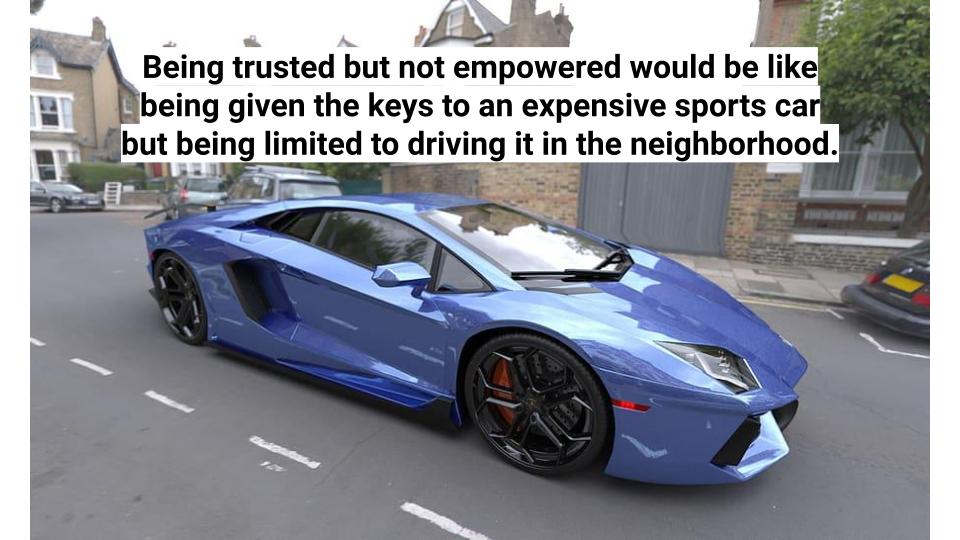
One of the discoveries I’ve made in my work with people from as diverse sectors as the military to ministry is the role that trust and empowerment play in creating the successful working relationships necessary to solve complex problems. And yet, very little is taught about these specific relational phenomena.
Have you ever taken a class in public school called How to be Trustworthy 101 or Self Empowerment for the Timid? If you have, it’s because you sought it out. Because this isn’t taught in schools. Yet, despite this lack of formal education on cultivating these attributes, most organizations–at least in theory–are looking for empowered people who can also be trusted.
Why do I have to hold their hands to get things done?

I’ve lost count of the number of people I’ve encountered who are frustrated by workers who cannot seem to accomplish certain tasks without having their hands held or being given explicit step by step instructions. To a person, these frustrated individuals are self empowered folks who, when given a task, will do everything in their power to accomplish it even if they break things and have to invent things along the way. Their frustration comes from the assumption that this self empowerment characteristic is a hallmark of being trustworthy. IT IS NOT.
When a person is trusted but not empowered, they experience taking actions that were not pre-approved by an authority as breaking a rule and a violation of the trust they have been afforded–EVEN IF THE ACTION IS IN SERVICE TO THE GOAL THEY ARE TASKED TO ACCOMPLISH.
Contrary to this, an empowered person experiences not taking an action that could help successfully accomplish their goal as a violation of their own sense of integrity–EVEN IF IN THE ATTEMPT TO THEY BREAK A FEW THINGS, TAKE SOME CALCULATED RISKS, AND MAY PISS A FEW PEOPLE OFF. They experience rules as suggestions or perhaps best practices. But, they will not be limited by them in the face of a possible better practice.
The fact is that no one way is right in every circumstance. It is situational. In the video below, I explain the nuances between trust and empowerment and how to determine what a role actually requires.
Here are some of my favorite questions to ask leaders to help them determine whether a role requires trust, empowerment or both. When answered honestly, these question can help unpack a lot of what frustrates both leaders and employees.
- What IS NOT WORKING about the team being trusted but not empowered?
- What IS WORKING about the team being trusted but not empowered?
- What are the concerns about the team becoming both trusted and empowered?
- What will be the benefits of the team being both trusted and empowered?
If you can resonate with what I’ve shared and would like to learn more, contact me and I can show you how we can work together to create custom trainings for your leaders or organization.
 Higher Up Consulting